

The year 2026 represents a historic turning point for the Brazilian economy. With the official start of the gradual transition to the **Tax Reform** approved by Congress, sectors such as construction, professional services, and home security begin operating under the new rules of the **Dual IVA (Value Added Tax)**. For companies specializing in fabricating, selling, and installing safety netting and insect screens, the direct tax impact on accounting is deep.
📌 What changes in 2026 during the Tax Transition?
In this first transition year (2026), the federal government and subnational entities implement a combined test rate of 1% (0.9% federal CBS and 0.1% subnational IBS) to calibrate digital collection and tax credit engines. While a modest value, the restructuring of fiscal processes requires companies to recalculate costs immediately to avoid losses when bidding residential and commercial contracts.
Topics Explored in this Article
- 1. The New Dual IVA Structure (CBS and IBS) in the Safety Screen Sector
- 2. Full Non-Cumulativity: Offsetting Tax Credits on Raw Materials
- 3. Fiscal Challenges of the Temporary Transition Phase in 2026
- 4. Labor versus Raw Materials: How Does it Affect the Final Consumer Price?
- 5. Urgency of Business Formalization: Tax Risks in Hiring Unlicensed Crews
1. The New Dual IVA Structure (CBS and IBS) in the Safety Screen Sector
The core concept of the reform is the gradual elimination of five traditional taxes that loaded production chains: PIS, Cofins, and IPI (federal), ICMS (state), and ISS (municipal). In place of this complex structure, two integrated taxes are introduced, forming the **Dual IVA**:
- CBS (Contribution on Goods and Services): Managed by the federal government, replacing PIS and Cofins.
- IBS (Tax on Goods and Services): Jointly managed by states and municipalities, replacing ICMS and ISS.
For safety screen installers, who previously paid municipal ISS (typically 2% to 5% of service invoice values) and state ICMS on resold materials, the consolidation simplifies invoicing but requires technological integration with the new national collection database.
The new rules state that taxation occurs at the point of consumption (destination principle), meaning taxes are collected based on rates at the client's city and state, not where the installer is based. This requires integrated, updated billing databases.
2. Full Non-Cumulativity: Offsetting Tax Credits on Raw Materials
The major benefit of the Dual IVA model lies in **full non-cumulativity**. In the previous system, when a company purchased rolls of high-density polyethylene (HDPE) mesh or aluminum profiles for insect screens, the ICMS and IPI paid on those purchases often pooled as raw costs, with no way to offset them against service ISS.
Starting in 2026, under CBS and IBS, every tax paid on raw materials generates an equivalent **tax credit**.
- Buying Materials: When the installer purchases certified NBR 16046 nets or metal frames, they pay the CBS/IBS shown on the supplier's invoice and accumulate tax credits in their digital account.
- Invoicing Services: Upon installing screens for clients and issuing the invoice, the company calculates the tax due on the sale/service.
- Offsetting: During monthly bookkeeping, the company deducts accumulated material credits from the total tax owed, paying only the net value added.
This mechanism directly benefits organized businesses purchasing from formal suppliers, enabling a notable reduction in material tax overhead.
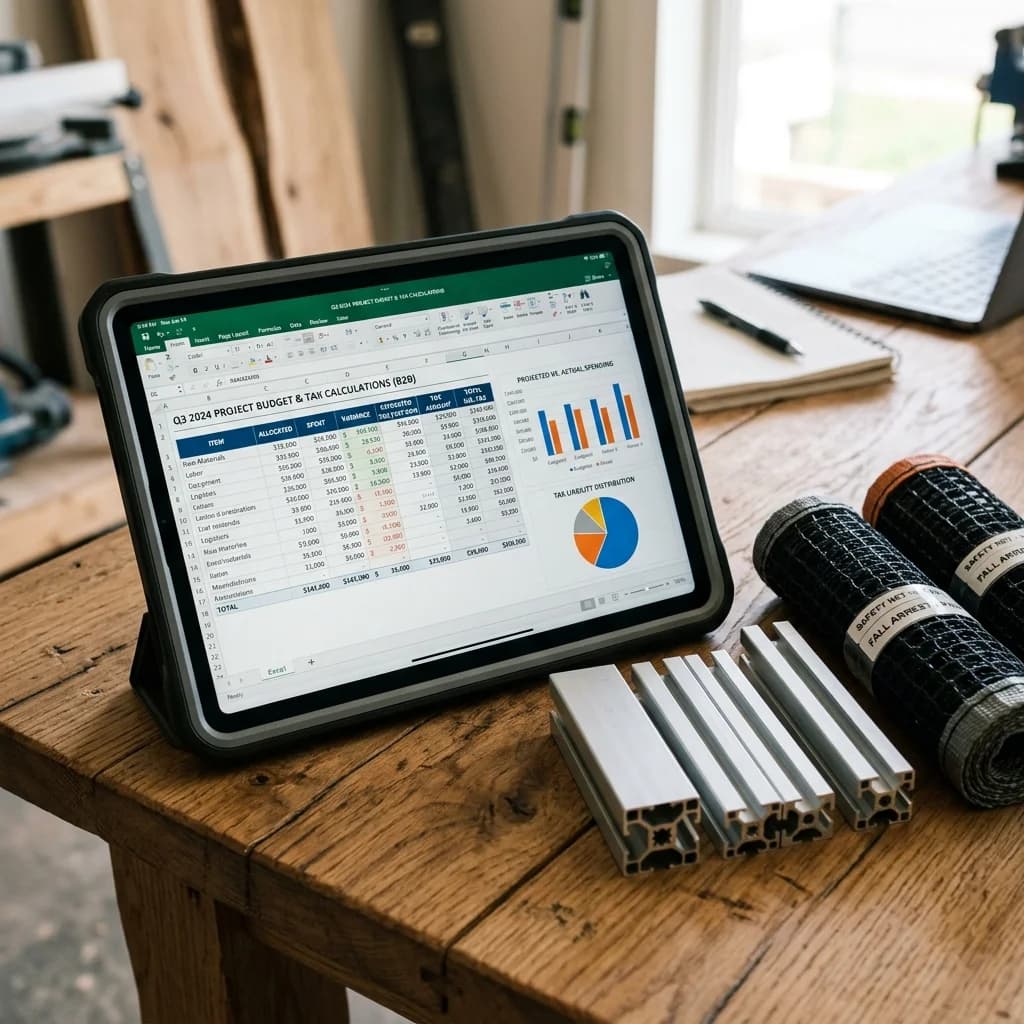
Precise control of digital tax credits via accounting software is key to sustaining competitive rates under the Dual IVA.
3. Fiscal Challenges of the Temporary Transition Phase in 2026
While the ultimate goal of the reform is total simplification by 2033, the initial transition in 2026 presents administration challenges for accountants and managers. During this test phase, old and new tax structures run in parallel.
**The 1% Pilot Rate:** In 2026, safety netting invoices will feature a pilot 0.9% CBS and 0.1% IBS charge, collected by the government to test digital settlement systems. Legacy taxes (PIS, COFINS, ISS, ICMS) remain active, slightly reduced to accommodate the pilot.
Invoicing teams must update billing platforms to ensure proper display of the new IVA fields. Formatting mistakes or software delays trigger penalties and block tax credits, eating into margins of active contracts.
4. Labor versus Raw Materials: How Does it Affect the Final Consumer Price?
A primary concern for property managers, condominium boards, and families is whether safety netting and insect screens will become more expensive under the new reform. The answer separates **materials** and **labor** costs.
**Material Cost Reductions:** As factories producing HDPE netting and extruded aluminum profiles receive exemptions on federal IPI and PIS/Cofins, wholesale material costs should remain stable or decrease slightly for installers.
**Labor Cost Pressures:** Services, which rely heavily on direct payroll, are expected to experience a higher nominal tax burden under CBS and IBS, as salaries do not generate offsetting tax credits.
Consequently, final quotes will depend on installer efficiency. Structured companies managing tax credits and negotiating bulk material purchases will balance the tax scale, keeping consumer prices competitive.

Businesses and condominiums require regular electronic service invoices to benefit from tax credits under the new system.
5. Urgency of Business Formalization: Tax Risks in Hiring Unlicensed Crews
Under the 2026 Dual IVA rules, informal labor ceases to be a "competitive cost-cut" and becomes a financial risk for consumers. In the old system, hiring unregistered crews without invoices simply bypassed taxes.
Now, with full non-cumulativity, hiring services without electronic service invoices (NFS-e) **blocks tax credits**. For commercial and residential condominiums, this translates to higher net costs, as they cannot deduct the service tax from corporate condo fees.
Furthermore, hiring unlicensed crews without active company registration (CNPJ) to install nets at heights exposes owners to severe civil and labor liabilities in case of accidents (NR 35 height safety standard), with zero product warranty on materials.
Transparent and Compliant Installation Invoicing
At UauTelas, we issue electronic invoices highlighting CBS and IBS for all safety netting and insect screen installations, ensuring compliance and peace of mind.